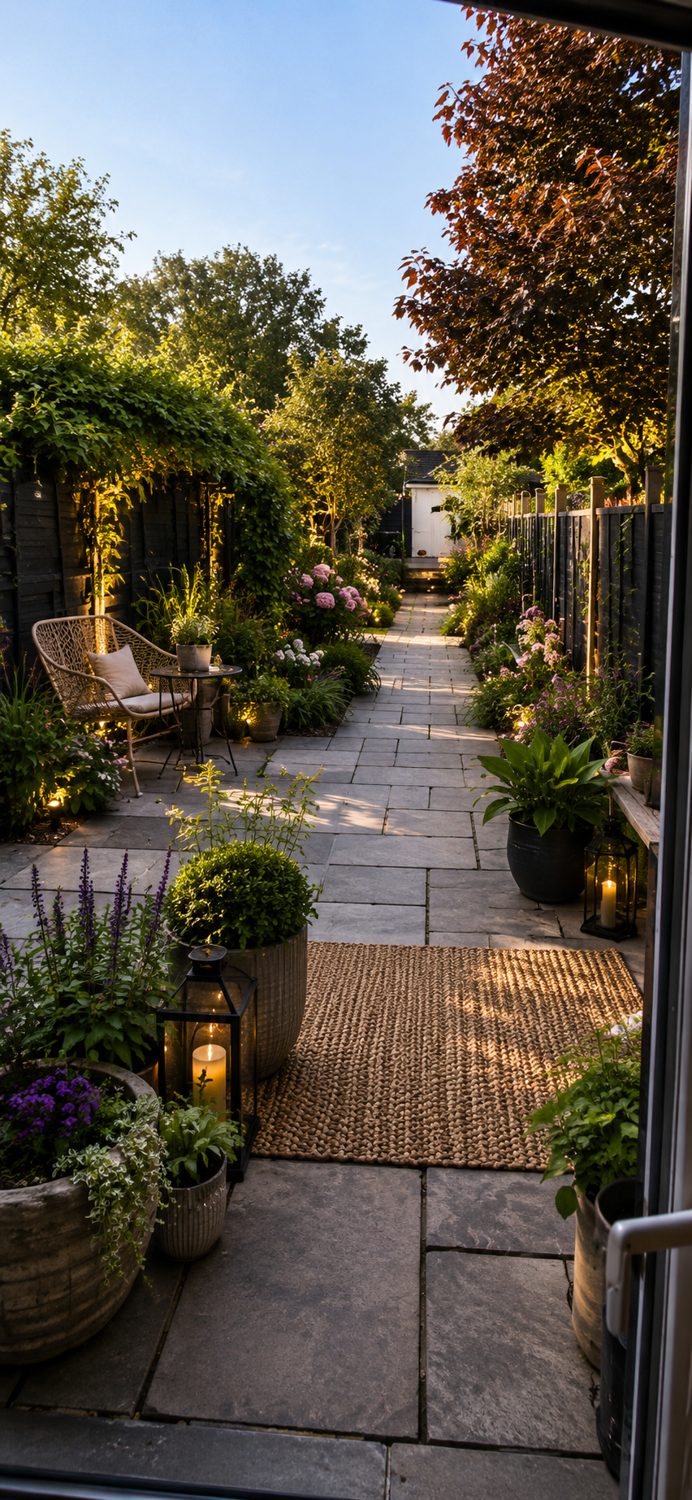

THE SHIFT
From patio to garden journey
Clear the hardscape, bring planting to the edges and use repetition to pull the eye down the garden. The seduction starts at the door.
Not a makeover. A three-year unfolding. We clear what is distracting us, keep what already has soul, build evergreen bones, then slowly add colour, water, movement and those little moments of magic.
South-facing • low budget • evergreen first • collected, not over-designedShirley already has the beginnings: mature planting, trees, climbers, pots, stone, a little Buddha and that black roll-top bath. We are not throwing that away. We are going to make it make sense.
The feminine feeling comes from softness, movement, fabric, water, dappled light, layers and somewhere private to disappear into. The Zen feeling comes from editing. Repetition. Breathing space. And knowing when enough is enough.
These visuals are the destination, not a shopping list. The point is to use Shirley’s own garden and let it build into this feeling over time.
Clear the hardscape, bring planting to the edges and use repetition to pull the eye down the garden. The seduction starts at the door.
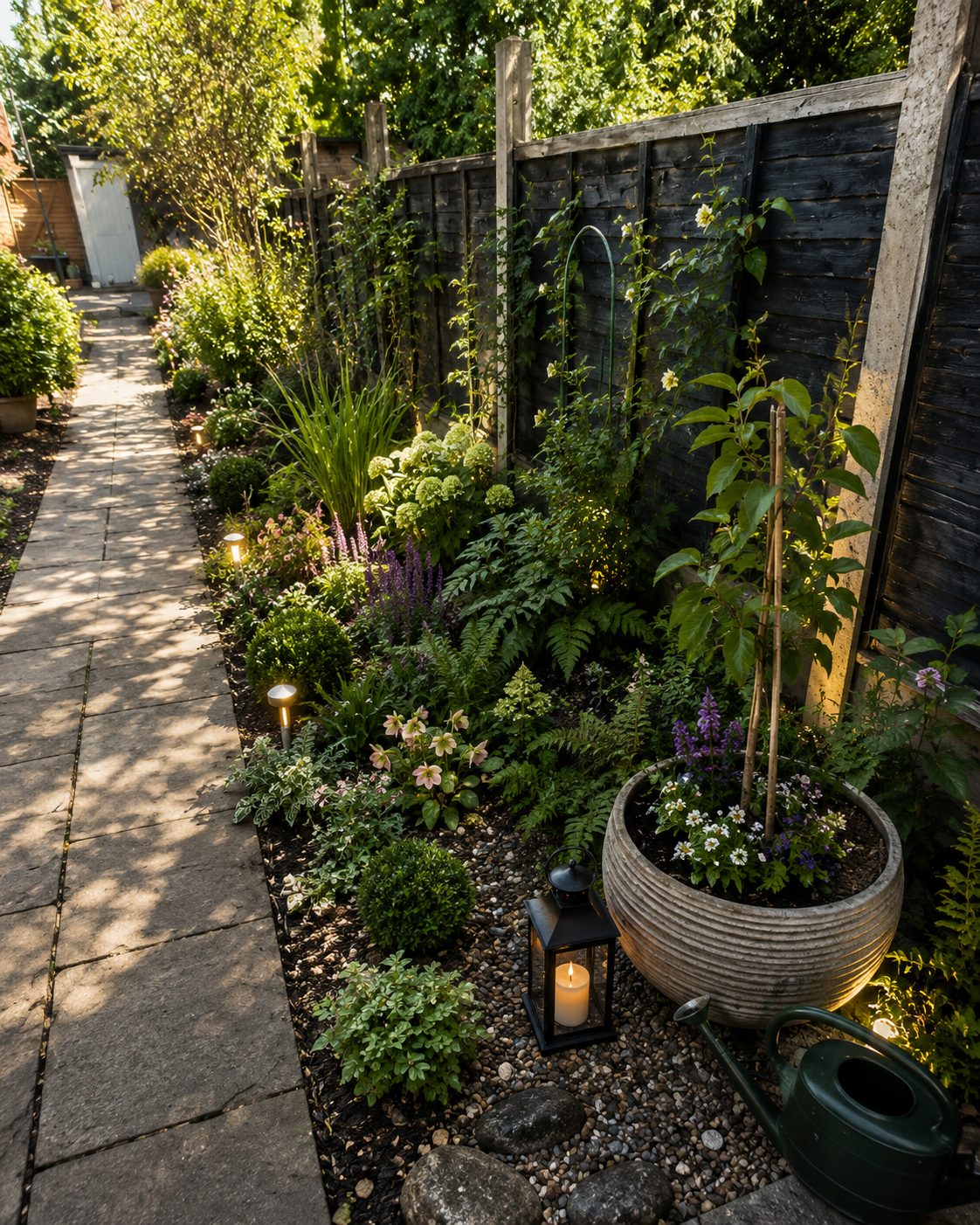

Plant out the strongest existing plants, add evergreen rhythm and let climbers soften the fence. Fewer pots. More garden.
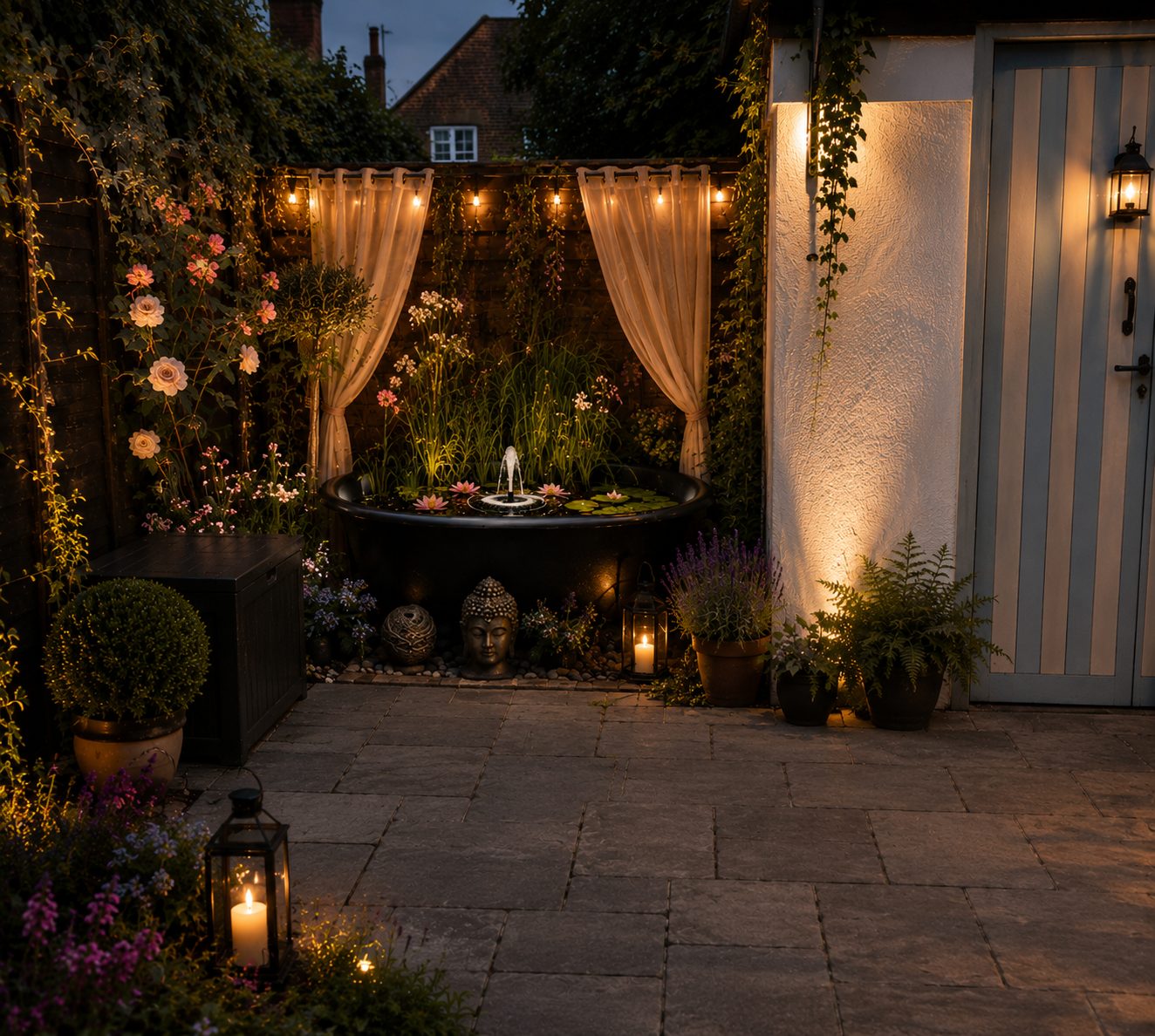

Keep the black exterior and pale interior. Turn it into a planted water feature with a gentle solar fountain, curtains, lanterns and planting that slowly swallows the edges.
Every loose pot comes out first. Dead, broken and random goes. Then we can actually see what Shirley owns.
Make most of the visual structure foliage that holds the garden together when flowers disappear.
The same fern, grass, colour and foliage shape appearing again and again is what makes the whole garden feel united.
The bath sanctuary should be glimpsed, not shouted. Curtains, climbers and planting give us seduction and discovery.
Keep the black exterior and pale interior. Don’t disguise it. Make it the thing the garden builds towards: a little living pond with a gentle sound of water and planting slowly claiming the edges.
This garden does not need fifty new varieties. It needs a small cast of characters that keep reappearing.
Winter backbone. Fewer varieties, repeated.
Softness comes from movement and layering, not pink everything.
Purple, lilac, burgundy and the occasional dusky accent.
Train vertically so the fence slowly disappears.
Keep the fountain gentle and leave a calm zone for lilies.
This is Shirley’s living garden diary. Tick each month as it happens and leave a note. Your ticks and notes save in the browser on this device.
Year 1: establish • Year 2: thicken • Year 3: edit + mature
Clear first. Remove dead pots, rubbish, broken furniture and anything that has no role in the finished garden. Group every living plant into KEEP / MOVE / PLANT OUT / PASS ON. Photograph the cleared garden before buying anything.
Define the planting beds and edges. Plant out suitable pot-bound plants while the soil is still warm. Start repeating plants instead of scattering single pots. Keep the mature trees and useful climbers that already give height and privacy.
Add the evergreen framework and climbers. Think winter first: if it will still look good with no flowers, it belongs in Shirley’s Zen Garden.
Mulch the beds and settle the planting. Add only a few larger stones or pebbles. Plant spring bulbs in drifts so colour emerges through the green instead of taking over.
Stand in the garden on a grey day. This is the truth test. Note every bare, ugly or visually noisy area. Don’t panic-buy. Use the winter view to decide where year-round structure is still missing.
Measure the roll-top bath, check that it holds water, inspect the waste outlet and decide how it will be sealed. Test where the solar panel gets direct sun. Sketch the simplest possible curtain frame.
Repair or repaint fencing only where needed. Add simple supports for climbers. Start the discreet curtain frame around the bath zone without turning it into a gazebo.
Add spring-planted perennials and ground cover. Divide or reposition existing plants where useful. Keep repetition going: the same fern, grass or foliage shape appearing again and again.
Convert the bath. Clean, seal and fill it. Add aquatic plants. Keep a calm section of water for the lily and make the fountain gentle rather than showy.
Plant around the bath so it begins to belong to the garden. Add climbers and airy planting around the curtain structure. Hang soft oatmeal/stone curtains once the frame feels right.
Bring in the pops: purple, blue-lilac, burgundy foliage and the odd dusky rose. Three of one plant often looks more designed than three unrelated plants.
Place the chair, lanterns and a tiny table. Let planting soften the paving edges. Move pots into families rather than lining them up. Take the first proper Year One photographs.
Compare the garden with August 2026. Photograph the same viewpoints. Move anything that is failing and note where colour disappears too early.
Fill structural gaps with more of the same evergreens already working. This is the year to repeat, not reinvent.
Add missing shrubs or climbers and move anything that is clearly in the wrong place. Add another drift of spring bulbs if needed.
Mulch, tidy the paths and protect vulnerable pots. Leave attractive seedheads where they add winter texture.
Look from the house. The garden should still feel like a garden. Note where the eye stops and where lighting needs moving.
Save side-by-side images from 2026 and 2027. Record what survived, what struggled, what surprised you and what now feels unmistakably Shirley.
Tidy climbers and shrubs according to their type. Do not shear everything into balls. The feeling comes from controlled abundance.
Divide successful perennials and move the divisions elsewhere. This is how the garden starts looking expensive without costing a fortune.
Remove excess pond debris, check the pump/fountain and divide aquatics if they are overcrowded.
Guide climbers onto the curtain frame and fences. Add just one climber if a large vertical gap remains.
Look at what already works and echo it elsewhere. Repeat the strongest purple, burgundy or soft-blue note rather than inventing a new colour scheme.
Sit in it. Move the chair. Watch where the evening light lands. The garden now needs fewer interventions and more enjoyment.
Photograph every original viewpoint again. The question is now: what can we remove so the good things breathe?
Thin crowded areas, transplant self-seeded or spreading plants, and correct scale problems before buying anything.
If any part still collapses visually in winter, add the final evergreen structure now. Target gaps rather than blanket planting.
Refresh gravel and pebbles, reset wobbly paving and make the stone feel calm again.
Review the garden at 5pm. Move lights so they skim foliage and trunks rather than flooding the whole garden.
This winter should prove the evergreen strategy. Photograph it. Anything still beautiful now has earned its place.
Prune, tie, reshape and remove anything that has become too dominant. Intentional, but never manicured.
Divide, propagate and relocate the garden’s own successes. Use what Shirley’s garden is already giving you.
Refresh the bath pond, thin aquatic growth and make sure the gentle fountain still leaves a calm area for lilies.
Refresh curtain ties/fabric if needed and train climbers so the frame increasingly disappears into the planting.
Deadhead, lightly shape, support tall stems and remove visual clutter. Keep movement and softness.
Photograph the same views from 2026. Create the full Before / Year One / Year Two / Year Three chronicle.
RHS references: trees & shrubs · perennials · water lilies · pond plants · evergreen structure.